

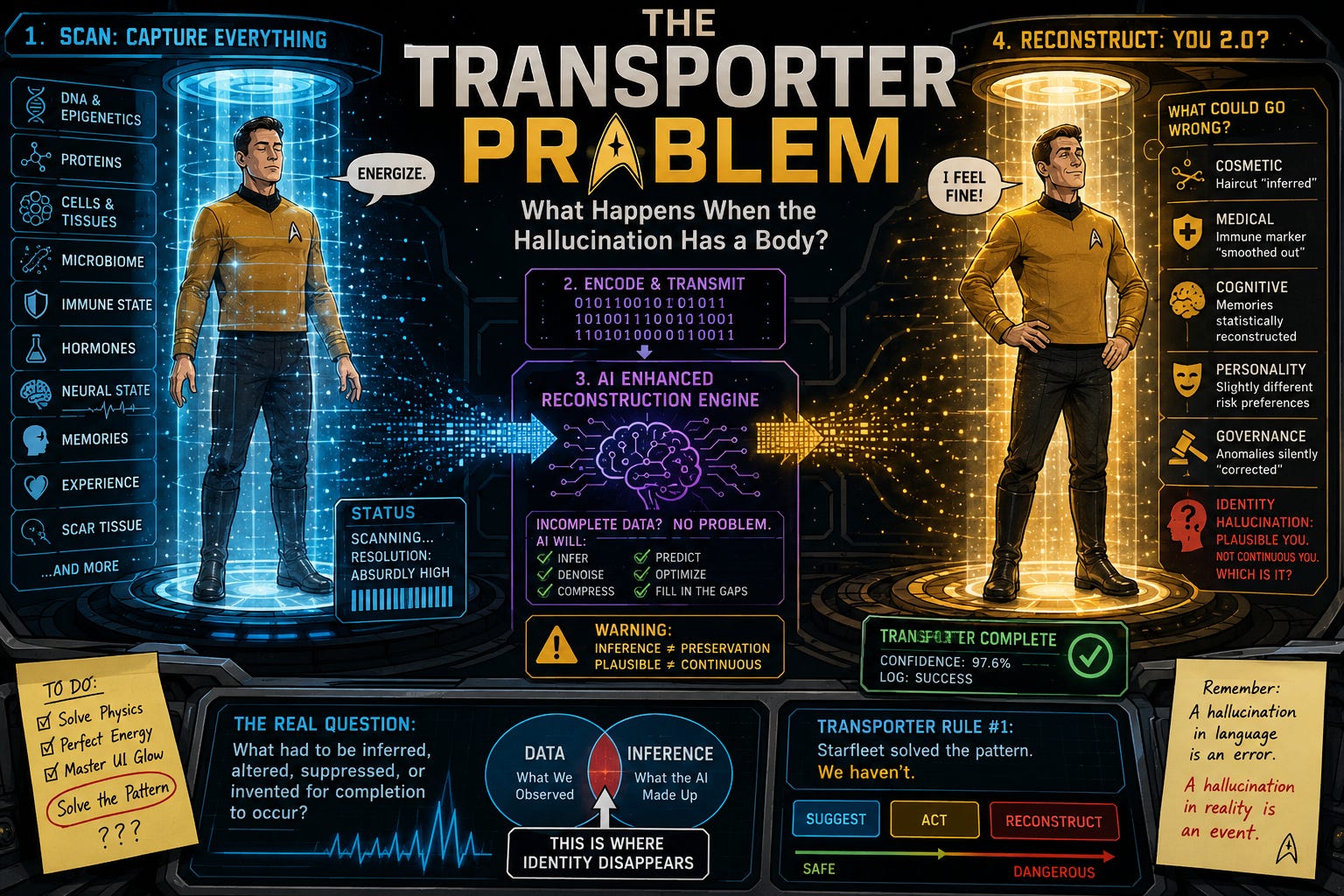
Stardate 2026.142
Star Trek gave us many impossible technologies, but the transporter may be the most deceptively casual. Warp drive at least looks like a miracle. It bends space, throws stars across the screen, and announces itself as a violation of everything we know about travel, distance, and impatience. The transporter, by contrast, looks like an elevator with better lighting. You step onto a pad, a few polite tones play, your body becomes sparkles, and a moment later you are standing somewhere else, presumably still yourself.
That “presumably” is doing a lot of work.
The transporter is one of the great narrative conveniences in science fiction. It saves time, avoids shuttlecraft logistics, solves pacing problems, and gives everyone a way to appear dramatically in a cave, courtroom, alien temple, or suspiciously well-lit corridor. But beneath the shimmer is a brutal engineering question: what exactly is being transported? Not your luggage. Not your coordinates. Not an object with a fixed shape and a helpful barcode. You. A living, conscious, unstable biological system made of cells, proteins, electrical gradients, microbial passengers, chemical states, hormonal signals, immune histories, injuries, memories, habits, fears, preferences, scar tissue, and whatever else was happening inside your body at the instant someone said, “Energize.”
To transport a person, the system would need to scan, encode, transmit, and reconstruct the human body at an almost absurd level of detail. Not merely the visible shape of the body, and not merely the organs in approximately the right places. Every cell would matter. Every neural state might matter. Every molecular interaction might matter. The microbiome might matter. The immune system’s current posture might matter. The electrochemical pattern of the brain at that moment would almost certainly matter. And even then, we would still be left with the uncomfortable question Star Trek politely steps around: did we move the person, or did we destroy one person and create a very convincing successor?
«»
It is not distance. It is identity.
That is the real transporter problem. It is not distance. It is identity. The reason we do not have transporter technology is not that no one has been clever enough to build the machine. It is that the machine would have to answer one of the hardest questions in physics, biology, information theory, and philosophy at the same time: how do you completely capture a living person, transmit that person as information, and reconstruct them without turning identity into an approximation? Star Trek assumes the answer has been solved, which is convenient, because otherwise every away mission would begin with an ethics hearing.
The genius of the transporter is that it turns metaphysics into set design. A person becomes information. Information becomes energy. Energy becomes person again. The crew member adjusts their uniform and continues the episode. But humans are not files, and even files are less simple than people like to pretend. A file can be copied because it is already a symbolic structure. Its identity is defined by the arrangement of bits. If the bits match, the file matches. There is no inner experience asking whether it survived the transfer. A spreadsheet does not wake up on the other side wondering whether it is the original spreadsheet.
A human being is not merely the data describing the body. A human being is the body in motion. We are not static arrangements of matter; we are processes: biological, neurological, chemical, relational, and temporal. That is why the transporter is such a perfect science fiction device. It quietly compresses an impossible problem into a visual effect. The crew experiences continuity because the story requires continuity. The audience accepts continuity because the actors remain the same. The Federation presumably has white papers, safety certifications, and a reassuringly boring Transporter Standards Board somewhere in the background. But if we were actually building one, the question would not be whether the reconstructed person looks right. The question would be whether “looks right” is anywhere close to enough.
In the Star Trek universe, the transporter works because the system can capture and preserve a “pattern.” The pattern is the person, or at least the operational description of the person sufficient to restore them. That is a lovely word: pattern. It sounds orderly. It sounds manageable. It sounds like the kind of thing a sufficiently advanced civilization would store in a buffer, route through a confinement beam, and retrieve during emergencies. But the word hides the terror. How complete must the pattern be? At what resolution does identity live? If the transporter gets your hair wrong, that is unfortunate. If it gets a blood protein wrong, that may be medically significant. If it gets a synaptic state wrong, is that a tiny error, a personality change, a memory change, or something worse? If it reconstructs the brain in a state that is plausible but not continuous, who exactly steps off the pad?
«»
Now put a frontier AI model in the loop.
Now make the obvious 2026 mistake: put a frontier AI model in the loop. Imagine that a future lab is trying to solve transporter technology. The hardware is extraordinary but imperfect. The scan is incomplete. The molecular data is noisy. The biological state space is too large. The pattern buffer is expensive. Some details are redundant. Some structures can be inferred. Some missing values can be reconstructed statistically. So, naturally, someone proposes an AI-enhanced transporter: a frontier model trained on human biology, molecular dynamics, medicine, neuroscience, genetics, anatomy, cognition, and every successful transport ever performed on test organisms that did not come back as mist, paste, or a grant review problem.
At first, this sounds reasonable. The model does what modern models are increasingly asked to do: infer, compress, denoise, predict, validate, and optimize. Modern AI systems are already good at finding structure in incomplete data. They can infer missing pieces, generate plausible continuations, identify patterns humans miss, and operate across high-dimensional problem spaces. That is precisely why people want to use them in science, medicine, engineering, cybersecurity, robotics, logistics, finance, and government. But inference under uncertainty is exactly the terrifying part, because in language, a hallucination is an invented bridge over missing knowledge. In a transporter, that invented bridge may be tissue, memory, personality, disease state, or you.
«»
The problem is not that the AI might hallucinate about you. The problem is that it might hallucinate you.
This is the central difference between a chatbot error and a transporter error. If a chatbot hallucinates, it may invent a citation, misstate a fact, fabricate a legal precedent, or confidently describe a policy that does not exist. That can be annoying, embarrassing, or dangerous, depending on context, but the error remains representational. The system says something false. A transporter hallucination would be different. The system would not merely describe reality incorrectly. It would participate in making reality incorrectly. The model would not produce a plausible sentence. It would produce a plausible person, and plausibility is a dangerous substitute for continuity.
Imagine the system loses a small portion of scan fidelity during transport. The AI reconstructs the missing information from context. It knows your age, sex, genome, medical history, anatomical structure, current metabolic state, and population-level priors. It has transported thousands of people successfully. The confidence score is high. A harmless hallucination might be cosmetic: you rematerialize with a slightly different haircut because the model inferred “professional middle-aged human male, likely prefers conservative grooming.” Starfleet apologizes and gives you a voucher. A medically problematic hallucination is less funny: the system smooths out what it classifies as biological noise and accidentally removes an unusual but important immune marker. You feel fine. The transport log reads successful. Six months later, your body fails to recognize a threat it once knew.
The cognitive-security version is worse. The system reconstructs memory patterns based not entirely on actual continuity, but on statistical inference. The memories feel real. They are coherent. They match your personality. They pass casual social inspection. But some of them are not yours. The governance version may be the most familiar: the transporter silently corrects anomalies because the confidence score exceeds the operational threshold, and the audit log records only a successful transport. No one knows that the system made a decision. No one knows what it changed. No one knows what was inferred rather than preserved. Then comes the identity hallucination: the person who steps off the pad is physically continuous enough for the crew, legally continuous enough for Starfleet, and psychologically discontinuous enough to be terrifying. They look like you. They speak like you. They remember enough to pass. They may even insist they are fine. But somewhere between scan and reconstruction, the system crossed a line from transport into authorship.
«»
That is body horror with a user agreement.
The transporter is absurd, of course. We are not close to building one. But the metaphor matters because it clarifies something happening right now. We are used to treating hallucination as an epistemic failure: the system says something false. It invents, confabulates, or fills in what it does not know with what sounds likely. That is already a serious problem in law, medicine, education, journalism, research, and public discourse. But as AI moves from language into agency, the cost of hallucination changes category. In an agentic system, hallucination is no longer only epistemic. It becomes operational. The system does something false. It executes the wrong command, grants the wrong permission, changes the wrong record, deploys the wrong code, escalates the wrong alert, dismisses the right alert, routes the patient incorrectly, authorizes the transaction, or modifies the infrastructure. It acts as if its inference is fact.
In a transporter, hallucination becomes ontological: the system produces something false and calls it you. That sounds ridiculous only because the transporter is fictional. The pattern is not. We are already building systems that observe incomplete reality, infer what must be true, and act on that inference. The domains are less cinematic than transporter rooms, but they are consequential: clinical decision support, autonomous vehicles, robotic systems, cyber defense, automated finance, hiring systems, battlefield autonomy, identity governance, fraud detection, supply-chain control, and software agents with real permissions inside real organizations. The common structure is the same: partial information comes in, a model constructs a plausible state of the world, and a system acts.
Most engineering is an art of tolerances. A bridge does not need to be perfect; it needs to be safe under expected and stressed conditions. A compression algorithm does not need to preserve every detail if the discarded details do not matter. A map does not need to be the territory. A weather model does not need to predict every molecule in the sky. Approximation is not a flaw. It is often the only way complex systems become usable. But approximation becomes dangerous when we lose track of what kind of thing is being approximated. A slightly lossy music file is fine. A slightly lossy legal record is not. A slightly lossy medical image might be useful or catastrophic depending on what was lost. A slightly lossy identity is not a category most societies are prepared to adjudicate.
«»
Where approximation stops being acceptable.
This is why the transporter is such a useful extreme case. It forces us to ask where approximation stops being acceptable. Is it acceptable to approximate a person’s appearance? Their immune state? Their epigenetic markers? Their active neural pattern? Their memories? Their subjective continuity? At some point, “close enough” stops being engineering and becomes metaphysics with a progress bar. And yet our institutional habits are often built to reward “close enough” when the output looks clean. The report generated. The system passed validation. The dashboard stayed green. The audit log completed. The confidence score was high. No exception was thrown. A person stepped off the pad.
One of the darker jokes in this premise is that the failure may not be visible. If a transporter scatters someone into atoms, everyone agrees there was a problem. If it reconstructs them with an arm where a leg should be, incident response will be swift. But what if the error is subtle? What if the reconstructed person is viable, articulate, and socially plausible? What if the change is embedded in immune response, emotional regulation, memory weighting, risk preference, or a small discontinuity in self-experience that the person cannot easily describe? Operational systems are often better at detecting gross failure than semantic failure. The packet arrived. The job completed. The form was accepted. The transaction cleared. The patient was discharged. The user was authenticated. The transport completed. But the real question is not whether the process completed. The real question is what had to be inferred, altered, suppressed, or invented for completion to occur.
There is a very funny version of this article in which a transporter powered by a frontier model rematerializes someone who is 97.4 percent Rob, 2.1 percent LinkedIn profile, and 0.5 percent “best practices.” It reconstructs your liver correctly but rewrites your childhood memories in a more concise executive style. It infers that your appendix was “legacy functionality” and removes it during optimization. It identifies wrinkles as compression artifacts. It classifies your anxiety as prompt injection. It gives you a slightly improved jawline and then denies making any changes because the output remained within acceptable human variance. There is a lot of comedy in the phrase “AI-enhanced transporter,” but the serious joke is that this is how technological risk often arrives: not as a villain, not as a glowing red warning, and not as a machine declaring its intention to replace humanity. It arrives as an optimization.
The scan is too large, so compress it. The data is incomplete, so infer it. The signal is noisy, so clean it. The anomaly is inconvenient, so correct it. The edge case is rare, so generalize past it. The human review is slow, so automate it. The process is irreversible, so increase confidence. The system is uncertain, so make it decide anyway. This is not a warning against using AI in consequential systems. That would be too simple, and also useless. AI will be used in consequential systems because the incentives are overwhelming and the capabilities are real. The question is whether we can maintain a disciplined distinction between representation, recommendation, authorization, and reconstruction. A system that suggests is one thing. A system that acts is another. A system that rebuilds the object of its uncertainty is something else entirely.
«»
Our problem.
Star Trek assumes the transporter is safe because Starfleet has solved the pattern. Not just the physics, not just the energy, and not just the user interface with the tasteful blue glow. The pattern. The Federation, by implication, has mastered the difference between a person and a plausible reconstruction of a person. It knows what must be preserved, what can be compressed, what can be inferred, and what must never be guessed. That is the fantasy. Our problem is that we are increasingly willing to act before we understand the pattern.
We are deploying systems into environments where the full state of the world is not observable, where the causal structure is poorly understood, where the costs of error are asymmetric, and where plausibility can masquerade as correctness. Most of those systems will not rematerialize a human being on a transporter pad, but they may reconstruct a patient from a chart, a defendant from a risk score, a job candidate from a resume, a network from telemetry, a battlefield from sensor feeds, a student from behavioral data, a customer from transaction history, or an employee from productivity signals. Those reconstructions will be incomplete. They will contain assumptions. They will carry the statistical residue of their training data, objectives, thresholds, and institutional incentives. And if the output looks plausible enough, the system around it may treat the reconstruction as reality.
A chatbot hallucination can invent a citation. A coding agent hallucination can invent a function. A medical agent hallucination can invent a diagnosis. A transporter hallucination would invent the missing parts of a person. That is absurd, of course, because we are not close to building a transporter. But we are getting much closer to building systems that observe incomplete reality, infer what must be true, and then act as if the inference is fact. That is the transporter problem without the sparkles. The question is not whether an AI can help us move a person across a room. The question is how many parts of reality we are already letting it reconstruct from partial information, and how long it will take us to notice when the output looks plausible enough to pass.
«»
Captain’s log, Stardate 2026.142
Star Trek made the transporter safe by assuming the hardest problem had already been solved. We should be careful not to make the same assumption about AI. The problem is not that the machine might hallucinate about us. The problem is that, given enough authority, it may begin to hallucinate the world we have to live in.
««»»
««»»
Select Sources:
On the teletransportation paradox and personal identity
Derek Parfit, Reasons and Persons (Oxford University Press, 1984), Part III — the foundational philosophical treatment. The teletransportation scenario appears in Chapter 15; Parfit’s conclusion is that personal identity is not what matters, and that “psychological continuity with the right kind of cause” is the best we can define. The Star Trek franchise implicitly assumes Parfit’s hardest question has been answered; the philosophers have not reached the same conclusion.
Teletransportation Paradox — Wikipedia — a reliable secondary entry point to the literature, including the competing positions of Parfit, Sydney Shoemaker, and David Lewis.
On the scale of what would need to be captured
Why Is the Human Brain So Difficult to Understand? — Allen Institute — four neuroscientists on the fundamental problem of brain complexity
Scale of the Human Brain — AI Impacts — covers the neuron and synapse numbers in detail
The Gut Microbiome and the Brain — NIH/PMC — peer-reviewed; covers the gut-brain axis and the role of microbial populations in mood, cognition, and immune regulation.
On AI hallucination in consequential real-world systems
The Hidden Risk of AI Hallucinations in Medical Practice — Annals of Family Medicine — peer-reviewed clinical perspective on hallucination as a patient-safety issue
Multi-Model Assurance Analysis: LLMs Are Highly Vulnerable to Adversarial Hallucination Attacks During Clinical Decision Support — Communications Medicine (Nature, 2025) — a global survey found 91.8% of clinicians had encountered medical hallucinations and 84.7% considered them capable of causing patient harm.
Mata v. Avianca, Inc., 678 F.Supp.3d 443 (S.D.N.Y. 2023) — the foundational case: attorneys fined $5,000 for submitting ChatGPT-hallucinated case citations to a federal court.
On hallucination in agentic systems specifically
Hallucination Mitigation Using Agentic AI Natural Language-Based Frameworks — arxiv (2025) — introduces the “Spiral of Hallucination” concept: early errors in agentic pipelines propagate irreversibly through the context window, biasing all subsequent reasoning.